
One of the most common concerns among people considering hair restoration is pain. It is a fair concern, and one that deserves an honest, evidence based answer. Most patients report far less discomfort than they expect, and what they do feel is mild and manageable.
In this blog we break down exactly what to expect at every stage, from the procedure itself to full recovery.
The procedure itself is generally painless, since, before the procedure starts, the medical team administers local anesthesia to numb the scalp completely, ensuring patients do not feel pain during extraction and implantation.
What patients typically notice during surgery is pressure and vibration, not pain. A retrospective cohort study of nearly 20,000 FUE patients found that pre-procedure pain expectations exceeded 7 out of 10, while actual post-operative pain scores averaged just 1.70 (firmly within the mild range on a 10 point scale).
That gap between fear and reality is one of the most consistent findings in hair restoration data, hair transplant pain is almost always less than patients anticipate.
The most painful step of the entire hair transplant process is the administration of local anesthesia itself. Most patients describe it as a brief stinging or pinching sensation that lasts only a few seconds per injection.
Once the scalp is numb, patients do not feel pain during the extraction phase, instead noticing slight pressure rather than actual discomfort.
The same applies to implantation. During a multi-hour procedure, the predominant experience is often boredom rather than discomfort, and many patients watch shows, listen to music, or simply talk with the surgical team. If sensation begins to return at any point, the surgical team can apply additional anesthesia immediately.
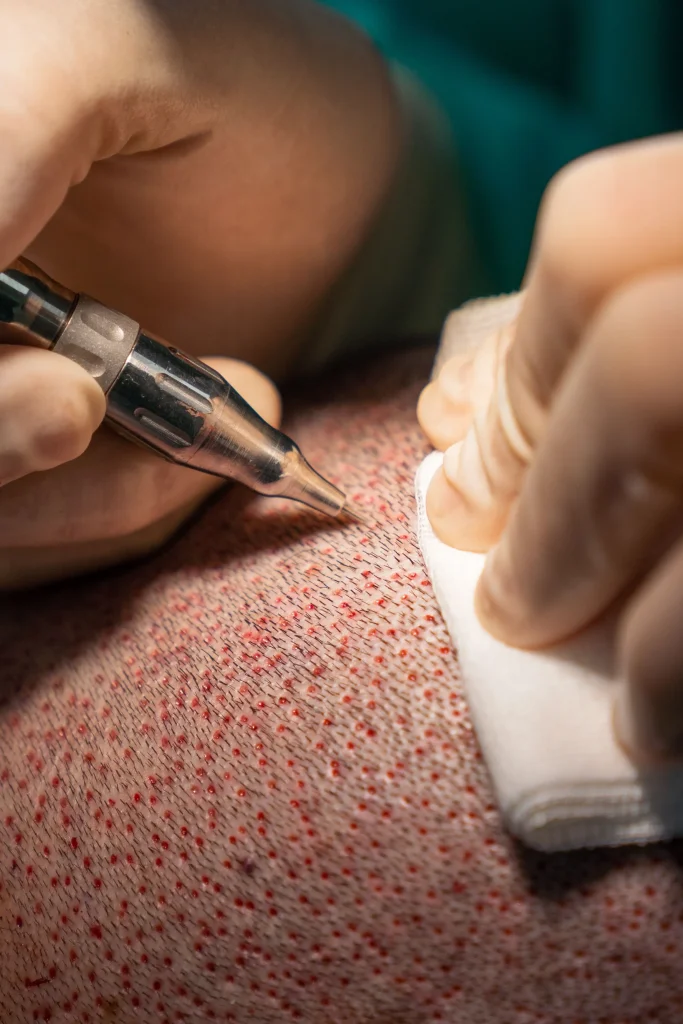
Patients who undergo FUE typically report only mild discomfort, often rating it between 0 and 2 on a 10 point scale. FUE extracts follicles individually using micro-punches, which reduces tissue trauma and typically shortens recovery discomfort compared to other techniques.
DHI uses a specialized implanter pen for more precise placement, which can result in less trauma to the scalp during implantation, and many patients report feeling comfortable with this approach. However, the dense implantation pattern used in DHI can increase short term tenderness at the recipient site compared to FUE.
Both techniques are considered minimally invasive, and the difference in comfort between them is generally small. FUT, by comparison, tends to cause slightly more soreness due to the presence of stitches in the donor area, with reported pain scores ranging from 1 to 4. For most patients, FUE and DHI offer the smoothest overall recovery experience.
Procedures involving a larger number of grafts naturally extend the time the scalp spends under treatment, which can slightly increase post-operative tenderness, particularly in the donor area.
Pain perception varies significantly from person to person. Surgeons take individual factors into account when planning pain management, since the same procedure can be experienced very differently from one patient to another.
As outlined above, FUE and DHI tend to produce less discomfort than FUT, primarily because they avoid the larger donor area wound associated with strip surgery. Following Post-Procedure Instructions
Most discomfort during hair transplant recovery occurs within the first 48 to 72 hours, then rapidly subsides. Pain after hair transplant typically peaks on the first day post op and then quickly begins to decrease.
Donor area discomfort, described as tightness or soreness, may last between 2 and 4 days before resolving. Normal sensations during this period include mild tightness, itching, minor swelling, and temporary numbness in the treated areas.
By the end of the first month, most discomfort has fully resolved. What remains during this stage is typically limited to:

Prescription pain medication is rarely necessary for FUE patients and only infrequently required even for FUT procedures.
Copyright © 2025 Cancun Hair Restoration. All rights reserved