
What if a naturally occurring molecule in your own body held part of the answer to hair thinning? Copper peptides for hair growth have moved steadily from laboratory research into clinical practice over the past decade, and the evidence behind them is more substantive than most people realize, though it comes with important nuances worth understanding before choosing this as part of a treatment plan.
Copper peptides, particularly GHK-Cu and AHK-Cu, are short amino acid chains bound to copper that activate hair follicle stem cells, extend the growth (anagen) phase, and trigger the Wnt/beta-catenin signaling pathway.
Endogenous levels of GHK-Cu decline with age, a drop that correlates with slower follicle cycling, thinner hair, and impaired scalp repair.
Today, GHK-Cu is used within regenerative medicine as a complementary agent to support scalp health and stimulate follicle activity, particularly when combined with delivery-enhancing methods such as microneedling.
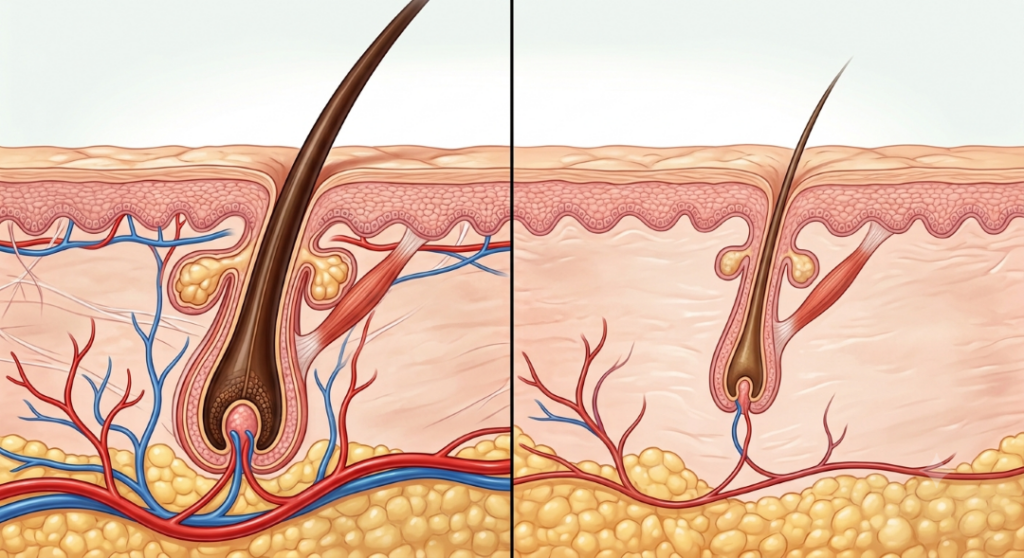
Hair follicle stimulation is one of the primary documented mechanisms of GHK-Cu. GHK-Cu supports hair follicle health primarily by upregulating growth factors (VEGF, KGF, and IGF-1) and reducing pro-inflammatory signals that accelerate follicle miniaturization. A 2024 microemulsion study found copper peptide treated follicles entered the growth phase in as few as 6 days, compared to approximately 9 days for minoxidil alone.
Beyond direct hair follicle regeneration, copper peptides contribute to tissue remodeling and wound repair in the scalp environment. GHK-Cu suppresses the perifollicular inflammation that quietly chokes follicles over time, creating a healthier environment for sustained growth.
Lab and small clinical studies show copper peptides can increase hair follicle size by up to 40%, boost density by 30 to 40%, and reduce shedding by 25 to 30% over 2 to 6 months of consistent use. These figures reflect hair density improvements that, while modest compared to surgical restoration, are clinically meaningful in early stage cases.
Early hair thinning
Patients noticing increased shedding or reduced density before significant follicle miniaturization has occurred
Male pattern hair loss
Early to moderate stages, as a complementary agent alongside finasteride or minoxidil
Female hair thinning
Particularly useful for diffuse thinning where non-surgical, low-risk approaches are preferred
Patients seeking non-surgical options
Those who are not yet candidates for a transplant or who prefer to exhaust regenerative approaches first
Patients combining regenerative therapies
Copper peptides pair well with PRP, exosome therapy, and microneedling as part of a multi-modal protocol
This comparison applies to fundamentally different stages of hair loss. Hair growth peptides support follicles that are still active, while a hair transplant addresses areas where follicles are no longer producing hair. For patients with advanced hair loss, no regenerative treatment replaces surgical restoration. However, copper peptides can complement post transplant recovery by supporting scalp health during the healing phase.
Exosome therapy delivers a more concentrated and diverse regenerative payload than either PRP or copper peptides, making it the more advanced option for patients who have not responded to other non-surgical treatments. Copper peptides, by contrast, are more accessible and better studied in topical delivery formats, making them a practical first line regenerative option before escalating to exosomes.
PRP uses the patient’s own concentrated platelets to stimulate follicle activity through direct growth factor delivery. It has a more established clinical evidence base than copper peptides, with over 15 years of supporting data. Copper peptides work best as part of a stack rather than as a sole therapy for moderate to severe pattern hair loss, and combining them with PRP targets complementary biological pathways simultaneously.
At Cancun Hair Restoration, the medical team evaluates each patient’s hair loss stage, scalp condition, and treatment history before recommending any protocol. CHR offers a full spectrum of hair restoration options, including non-surgical regenerative therapies and advanced surgical techniques, all delivered by a certified team with over 20 years of combined experience and full bilingual support for international patients.
Depending on the clinical evaluation, the following treatments may be recommended alongside or instead of copper peptide therapy:
PRP Therapy
Growth factor injections to stimulate active follicles
Exosome Therapy
Advanced regenerative option for patients who have not responded to PRP
Robotic FUE for precise, minimally invasive permanent restoration
FUE Hair Transplan
The most widely used surgical technique for natural, scarless results
Personalized Hair Restoration Plans
Multi-modal protocols combining regenerative and surgical approaches based on individual diagnosis
No single treatment works equally well for every patient. The right approach depends on the stage of hair loss, the condition of the donor area, the patient’s treatment history, and their long-term goals. The strongest protocols combine multiple approaches, and identifying which combination is most appropriate for a specific case requires a professional evaluation, not a generic recommendation.
Copyright © 2025 Cancun Hair Restoration. All rights reserved