A receding hairline is often the first visible sign of hair loss, and for many people, it is also the first moment they start seriously considering a permanent solution. DHI for receding hairline restoration is one of the options that comes up early in that research, and for good reason. But whether it is the right technique for a specific case depends on factors that only a proper clinical evaluation can determine.
This page explains how DHI works in the context of frontal hair loss, what a natural-looking result actually requires, and what to consider before requesting a consultation.
In most cases, a receding hairline is an early expression of androgenetic alopecia, the hereditary form of hair loss driven by genetic sensitivity to DHT. It typically begins at the temples and progresses inward, gradually reshaping the frontal hairline over months or years.
What matters clinically is not just how far the hairline has receded, but whether the loss is still progressing. Restoring a hairline while hair loss continues to advance requires planning that accounts for future changes, because the relationship between the restored area and the surrounding hair will shift as more follicles are affected over time.
This is one of the reasons a thorough patient evaluation comes before any technique recommendation.
DHI (Direct Hair Implantation) is a variation of FUE in which extracted follicles are implanted directly into the recipient area using a specialized pen-shaped instrument, without the need to create separate channels in advance. This allows the surgeon to control the angle, direction, and depth of each graft with a level of precision that is particularly relevant in the frontal zone.
In the context of a DHI hair transplant for receding hairline restoration, this precision matters because:
A DHI hairline transplant does not simply fill in a receded area. It reconstructs the transition between the forehead and the hair-bearing scalp in a way that looks continuous with the patient’s existing hair.
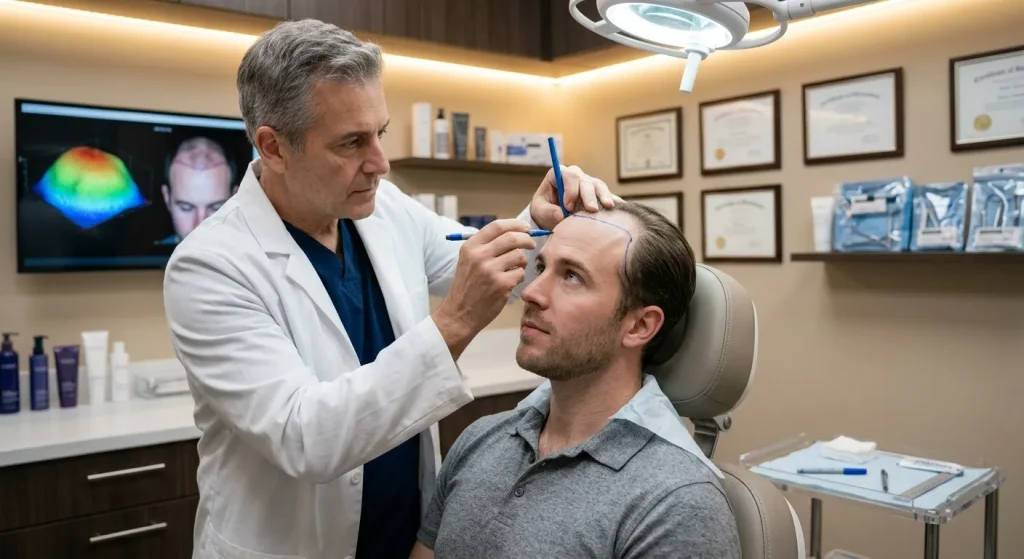
Hairline design is one of the most technically and aesthetically demanding aspects of any frontal restoration procedure. A natural result depends on several decisions made before a single follicle is implanted:
the proposed hairline must be appropriate for the patient's face shape, forehead height, and age. A hairline that is placed too low or too straight can look unnatural even when the surgery itself is technically well executed.
natural hairlines are not uniform. They have micro-irregularities and transitional zones where single-hair grafts blend gradually into the denser area behind them.
the restored zone must integrate seamlessly with whatever hair the patient currently has, both at the time of surgery and as the hair continues to evolve.
the design should remain coherent if additional hair loss occurs in adjacent areas, avoiding a situation where the restored hairline becomes isolated from the rest of the scalp coverage.
A natural-looking hairline is the result of surgical precision combined with an understanding of facial aesthetics, not simply the placement of grafts in a receded area.
DHI for frontal hair loss may be worth exploring with a specialist if several conditions are present. During a clinical evaluation, the surgeon typically reviews:

What hairline design are you proposing for my face, and why?
How many grafts do you estimate my case requires, and how was that number determined?
What is the condition of my donor area, and is it sufficient for the restoration I am considering?
What is the condition of my donor area, and is it sufficient for the restoration I am considering?
Is my hair loss still progressing, and how does that affect the timing or planning of the procedure?
Is DHI the most appropriate technique for my case, or would FUE or another approach be more suitable?
What does post-operative follow-up look like, particularly for patients returning to the United States or Canada?
What results are realistic for my specific pattern of loss and donor density?
At Cancun Hair Restoration, frontal hairline restoration is approached as a clinical and aesthetic decision that begins with a thorough individual evaluation. The medical team, led by Dr. Carlos Alejos and supported by specialists with over 20 years of combined experience, reviews each patient’s hair loss pattern, donor area, and long-term goals before recommending any technique.
CHR offers DHI alongside FUE, ARTAS, and FUT, which means the recommendation is based on what suits the patient’s case, not on a single technique the clinic defaults to. Full bilingual support in English is available throughout the entire process, including remote follow-up for patients returning to their home country after the procedure.
Contact Cancun Hair Restoration today!
Copyright © 2025 Cancun Hair Restoration. All rights reserved