
Postpartum Hair Loss: When Should You Worry?

Woman looking at her front hairline in the mirror, experiencing the first visible signs of postpartum hair loss.

Postpartum Hair Loss: When Should You Worry?

Losing large amounts of hair after having a baby is one of the most common experiences for new mothers, yet it remains underdiscussed. For many women, it happens suddenly and unexpectedly, and the volume of shedding can be alarming. The good news is that, in most cases, postpartum hair loss is temporary. The important question is: when does it stop being a normal part of recovery and start being something that requires medical attention?

What Is Postpartum Hair Loss?

Hair loss after pregnancy, clinically known as telogen effluvium postpartum, is a condition in which a large number of hair follicles simultaneously enter the resting phase of the hair growth cycle, triggering a surge of shedding weeks later.

During pregnancy, elevated estrogen levels extend the active growth phase of the hair cycle, which is why many women notice thicker, fuller hair while pregnant. After childbirth, estrogen levels drop sharply, and those follicles that were held in the growth phase are released together, producing the noticeable hair shedding after giving birth that most new mothers experience.

This is not hair falling out due to damage. It is the body recalibrating after a major hormonal shift.

When Does Postpartum Hair Loss Start?

The timeline is fairly predictable. Shedding typically begins 2 to 4 months after delivery, peaks around month 4 to 5, and gradually resolves as hormone levels stabilize.

Postpartum alopecia in women follows a general pattern:

Months 1–2

Little to no visible change

Months 3–4 

Noticeable increase in daily shedding

Month 5 

Shedding typically peaks

Months 6–12  

Gradual reduction and recovery of normal density

How Long Does Postpartum Hair Loss Last?

For most women, postpartum hair loss resolves within 6 to 12 months after giving birth, with hair returning to its pre-pregnancy thickness as hormone levels normalize.

Hair loss during breastfeeding may extend the shedding period slightly, since hormonal fluctuations continue throughout the nursing phase

This does not mean breastfeeding causes permanent hair loss, it simply means the hormonal timeline is longer for some women.

When Should You Be Concerned?

Female hair loss after having a baby is normal within the parameters described above. However, there are specific signs that warrant a consultation with a specialist:

Woman looking at her front hairline in the mirror, experiencing the first visible signs of postpartum hair loss.

For typical telogen effluvium postpartum, no medical treatment is required, the condition resolves on its own. However, several supportive approaches can help manage the experience and accelerate recovery:

Balanced nutrition

Adequate protein, iron, zinc, and biotin support follicle health during recovery

Gentle hair care

Avoiding heat styling, tight hairstyles, and harsh chemical treatments reduces additional stress on fragile hair

Volumizing shampoos and conditioners

Improve the appearance of density during the shedding phase

Stress management

Chronic stress can prolong telogen effluvium independently of hormonal factors

PRP for Postpartum Hair Loss

For women whose hair does not recover fully, or who present with an underlying hair loss condition revealed by the postpartum episode, PRP (Platelet-Rich Plasma) therapy is one of the most effective non-surgical interventions available. PRP involves injecting concentrated growth factors derived from the patient’s own blood directly into the scalp, stimulating dormant follicles and accelerating the return to the active growth phase.

PRP for postpartum hair loss is particularly well-suited for women who are not candidates for surgical procedures but need targeted clinical support beyond lifestyle management.

When a Specialist Evaluation Makes the Difference

If your hair has not recovered to its normal density within 12 months of delivery, or if you notice the signs described above, a clinical evaluation is the most important next step. 

A certified hair restoration specialist can determine whether you are experiencing a delayed recovery from telogen effluvium, an underlying androgenetic condition, or another treatable form of hair loss, and recommend the appropriate course of action based on your specific case.
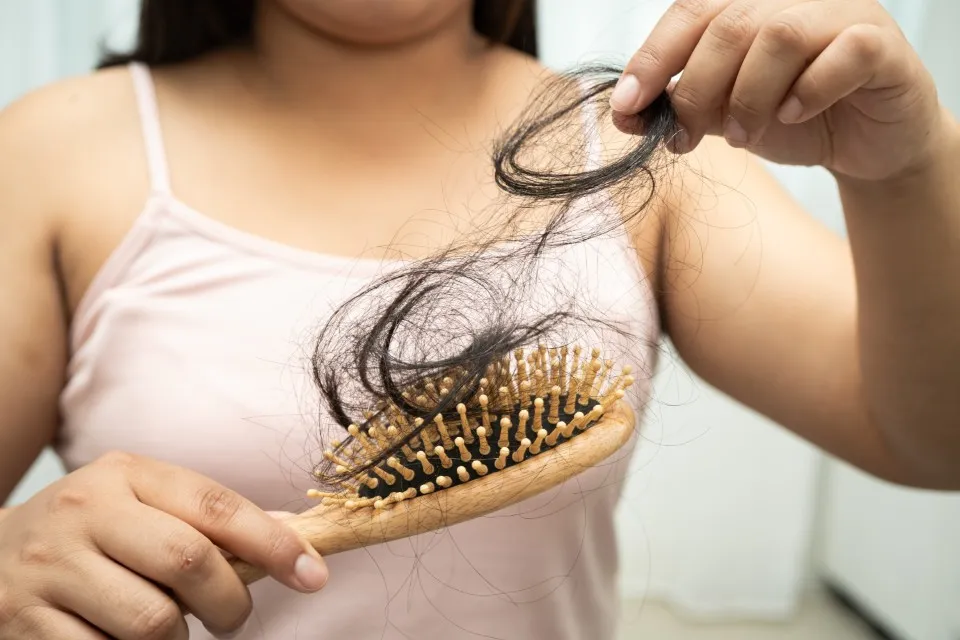
Close-up of a woman pulling a large clump of loose hair from a wooden brush caused by postpartum hair loss.

Cancun Hair Restoration: Specialized Care for Women's Hair Loss

At Cancun Hair Restoration, the medical team evaluates each patient individually, including women experiencing prolonged or complicated postpartum hair loss. From PRP therapy to advanced non-surgical treatments and, when indicated, surgical restoration, every treatment plan is built around the patient’s clinical profile and long-term goals.

If you are concerned about your hair loss after pregnancy, do not wait for it to resolve on its own indefinitely. A professional evaluation provides clarity and, when needed, a clear path to recovery.

Contact Cancun Hair Restoration today and schedule a personalized consultation.

Minoxidil vs Hair Transplant: Which Is Better Long-Term?

Smiling man checking his dense hairline in the mirror, evaluating a minoxidil vs hair transplant treatment.

Minoxidil vs Hair Transplant: Which Is Better Long-Term?

If you are dealing with hair loss, two options will come up in almost every conversation: minoxidil and hair transplant surgery. Both are widely used, both produce results, whoever, they both work in fundamentally different ways, and their long-term outcomes are not comparable.

In this post we break down the key differences so you can make a confident, informed decision about which path is right for you.

What Is Minoxidil and How Does It Work?

Minoxidil is a topical medication applied directly to the scalp, available over the counter in 2% and 5% concentrations. It was originally developed as a blood pressure medication and later approved by the FDA for hair loss after researchers observed that it stimulated follicle activity.

Minoxidil 5% for androgenetic alopecia, which is the most common form of genetic hair loss in men, is currently one of the most prescribed non-surgical treatments available. It works by widening blood vessels around the follicle, which increases nutrient delivery and extends the active growth phase of the hair cycle.

Does Minoxidil Work Long-Term?

Minoxidil can slow hair loss and, in some cases, stimulate regrowth in follicles that are still active, but it does not produce permanent results. The moment a patient stops using it, hair loss resumes, often returning to the pre-treatment baseline within months. For minoxidil permanent results to be maintained, the medication must be applied consistently, indefinitely. This makes it a management tool, yet not a solution.

Difference Between Hair Transplant vs Medication

The fundamental distinction between hair transplant vs medication comes down to the permanence.

A hair transplant relocates genetically resistant follicles from the donor area, typically the back and sides of the scalp, to thinning or bald zones. Once transplanted, these follicles retain their original resistance to DHT (the hormone responsible for androgenetic alopecia) and continue producing hair permanently, without ongoing treatment.

Minoxidil, by contrast, does not address the underlying cause of hair loss. It works only as long as it is actively used.

Minoxidil Before Hair Transplant: Is There a Role for It?

Yes, and this is an important nuance that is often overlooked. Minoxidil before a hair transplant can serve a useful clinical purpose in certain cases:

This does not mean minoxidil is a prerequisite for surgery, but it illustrates that both approaches are not always mutually exclusive.

Should You Stop Minoxidil After a Transplant

Whether to stop minoxidil after a transplant depends on each patient's individual case.

Transplanted follicles do not require minoxidil to survive, we reiterate, they are permanently established once the procedure is complete. However, a specialist may recommend continuing it to protect non-transplanted follicles that remain vulnerable to ongoing hair loss.

This decision should always be made in consultation with the treating physician.

Alternatives to Hair Transplant: What Else Is Available?

For patients who are not yet candidates for surgery, or who prefer to explore non-surgical options first, the most commonly used alternatives to hair transplant include:

Minoxidil

topical treatment for slowing loss and stimulating regrowth

Finasteride

oral medication that reduces DHT levels in the scalp

PRP therapy

platelet-rich plasma injections that stimulate follicle activity

Scalp Micropigmentation (SMP):

non-surgical pigment application that replicates the appearance of follicles

Each of these options addresses hair loss differently, and none produces the permanent, natural regrowth that a hair transplant delivers.

Minoxidil Hair Transplant
Results Temporary Permanent
Requires ongoing use Yes No
Addresses hair loss cause No Yes
Natural regrowth Limited Full
Suitable for advanced loss No Yes

Hair Loss Treatment for Men: When Is a Transplant the Right Choice?

A hair loss treatment for men that includes surgery is typically recommended when:

A thorough clinical evaluation is the only reliable way to determine candidacy.

Why Choose Cancun Hair Restoration?

At Cancun Hair Restoration, certified specialists evaluate each patient's hair loss pattern, donor area, and long-term goals before recommending any treatment. Whether the right path is FUE, ARTAS, DHI, or a combination approach that includes supportive medical therapy, every plan is built around the individual, not a standard protocol.

We offer:

Contact Cancun Hair Restoration today and take the first step toward a permanent solution.

Does Hair Transplant Leave Visible Scars?

A young man looking in the mirror to check his hairline, asking does hair transplant leave visible scars.

Does Hair Transplant Leave Visible Scars?

One of the most common concerns among first-time hair transplant candidates is scarring. It is a fair question, and we know is one that deserves an honest, detailed answer. The short version: it depends entirely on the technique used. Some procedures leave a permanent linear scar. Others leave virtually no trace at all.

Here, in this post, we discuss what every patient should understand before choosing a hair restoration method.

Not all hair transplants are performed the same way. The two primary surgical methods (FUT and FUE) produce very different outcomes when it comes to visible marks on the scalp.

FUT Linear Scar

FUT (Follicular Unit Transplantation) involves removing a strip of scalp tissue from the donor area, typically the back of the head, to extract individual follicular units. This process leaves a FUT linear scar that runs horizontally across the donor zone.

The scar itself can vary in width and visibility depending on the patient's healing response and the surgeon's technique. In most cases, it is concealed by surrounding hair at normal lengths, but it becomes visible when hair is cut short or shaved.

For patients who prefer shorter hairstyles, the FUT linear scar is an important factor to weigh before committing to this method.

FUE Hair Transplant Scar

FUE (Follicular Unit Extraction) is a fundamentally different approach. Rather than removing a strip of tissue, individual follicles are extracted one by one using a micro-punch tool, which leaves only tiny, circular hair graft marks scattered across the donor area.

These marks are significantly smaller than a FUT scar and, in most cases, heal to the point where they are not visible to the naked eye, even at short hair lengths.

ARTAS Hair Transplant

The ARTAS robotic system takes FUE a step further by using assisted technology to map and extract follicles with a level of consistency that is difficult to achieve manually.

The result is a more uniform extraction pattern, which means ARTAS hair transplant scarring is typically even less noticeable than standard FUE, with minimal trauma to the surrounding tissue and a faster healing process.

Hair Transplant With No Visible Scar: Is It Possible?

For the right candidate, a hair transplant with no visible scar is a realistic outcome. FUE and ARTAS procedures, when performed by an experienced and certified specialist, produce results where the donor area heals cleanly, with no detectable marks at standard hair lengths.

The key factors that determine whether scarring is visible include:

Surgeon experience and technique

precise extraction minimizes tissue damage

Patient healing capacity

individual biology plays a role in scar formation

Post-operative care

following recovery protocols reduces inflammation and supports clean healing

Hair density in the donor area

sufficient surrounding hair helps conceal any minor marks

How to Hide a Hair Transplant Scar?

For patients who already have a FUT scar from a previous procedure, or who experience more visible healing than expected, there are effective options for hair transplant scar camouflage:

Scarless Hair Transplant in Mexico: What CHR Offers

At Cancun Hair Restoration, FUE and ARTAS procedures are performed by a certified medical team in hair restoration. Every treatment plan is customized after a thorough pre-operative evaluation, we make sure that the technique selected is the one most appropriate for each patient’s scalp, hair type, and aesthetic goals.

CHR offers:

Contact Cancun Hair Restoration today and get an evaluation.